
Whenever I talk to my international friends about Germany, few have heard of Mainz. It only falls into place on their internal map of Germany when I add: “It’s near Frankfurt.” But few plan to visit, and instead list Hamburg, Berlin or Munich as their must-see destinations.
As a born Meenzer (local slang for us Mainz people) that is outrageous to me, not just because it’s my home town, but because Mainz actually has a ton of interesting things to see. At over 2000 years old and the state capital of Rhineland-Palatinate, it offers historic sights, museums, a lovely pedestrianized Old Town, river cruises down the Rhine, bike tours, I don’t even know where to end this list.
So if you find yourself on yet another layover in Frankfurt Airport and looking for something new to do and see, Mainz is just a short S-Bahn ride away.
Why you should see Mainz to begin with
Mainz was originally founded as a Roman garrison, Mogontiacum. The joke in Mainz goes that you can’t do any construction work without accidentally uncovering Roman remains (or unexploded bombs from WWII for that matter). So historic Roman sites can be found aplenty here, the formerly northernmost frontier of the Roman Empire.
Centuries later, a little thing called the printing press was invented here. And although most if not all of the town center was razed to the ground during WWII by repeated air raids, it has been rebuilt into the modern city that it is today.
I just love Mainz. It has such a friendly vibe. In summer, all the bars and restaurants have outdoor seating and with the breeze blowing over from the river the air always feels fresh. It probably also has to do with the fact that most major sights are in pedestrian areas, so the lack of traffic and noise adds to the persistent feeling of being on vacation even if you live and work there.
I don’t know what the usual travel guides say the must-sees are, but I was born and raised here and whenever I get visitors, these are the things I will show them, in no specific order (or jump directly to the map).
1 – Mainzer Dom (Cathedral)
Ok, so this one is a given and not really a secret, but it is damn cool. The Dom is on literally everything Mainz-branded and it is the first thing you will see across the river when you’re arriving by train from Frankfurt.
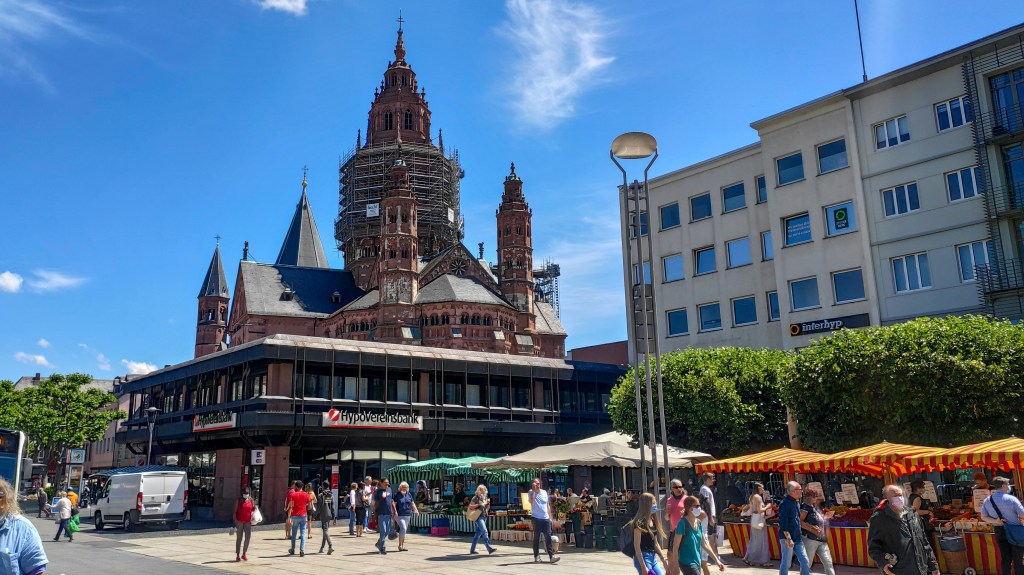
It is huge. It is old. It has secret crypts. It has a hidden marker on one of its inside columns marking 80m above sea level.
Okay, it may have burnt down once or twice or seven times (as of time of writing; 2020 isn’t done yet), but nonetheless it celebrated its 1000th anniversary back in 2009.

2 – Chagall windows (Saint Stephan)
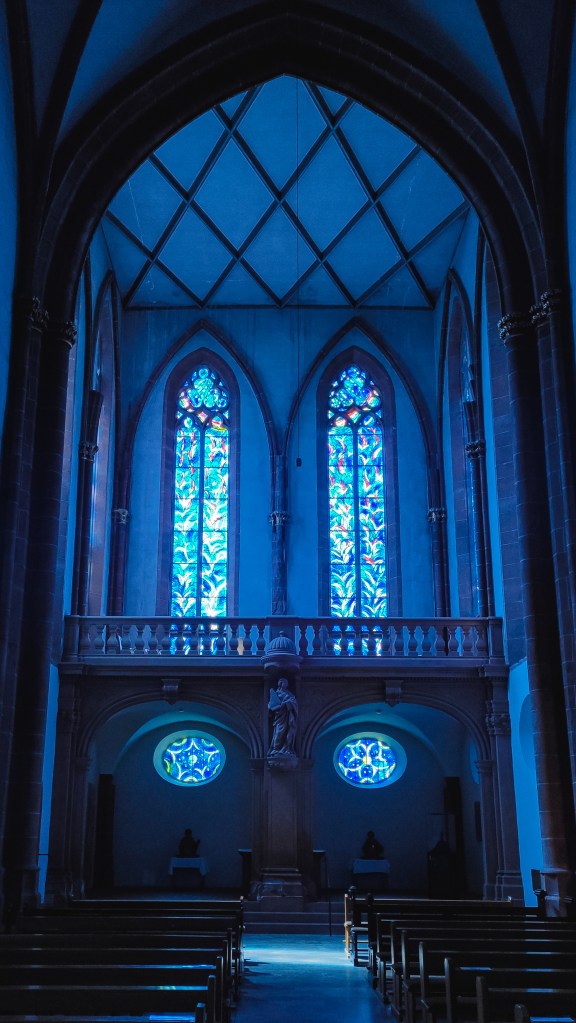
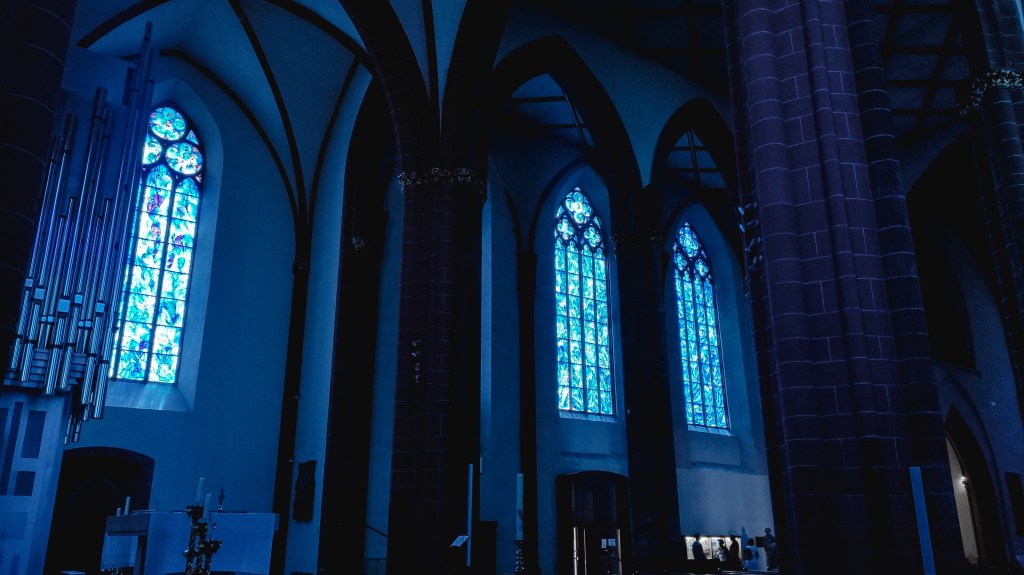
The one single church in Germany that boasts windows designed and created by Marc Chagall. That in itself would be quite the claim to fame, but actually it’s also a beautiful sight that you shouldn’t miss regardless. The blue ceiling-high windows all around the nave create the most serene and relaxing atmosphere. Just sit down in the pews for a minute and bask in the light.

Before you leave make sure to check out the organ which is designed in a beautiful modern style.
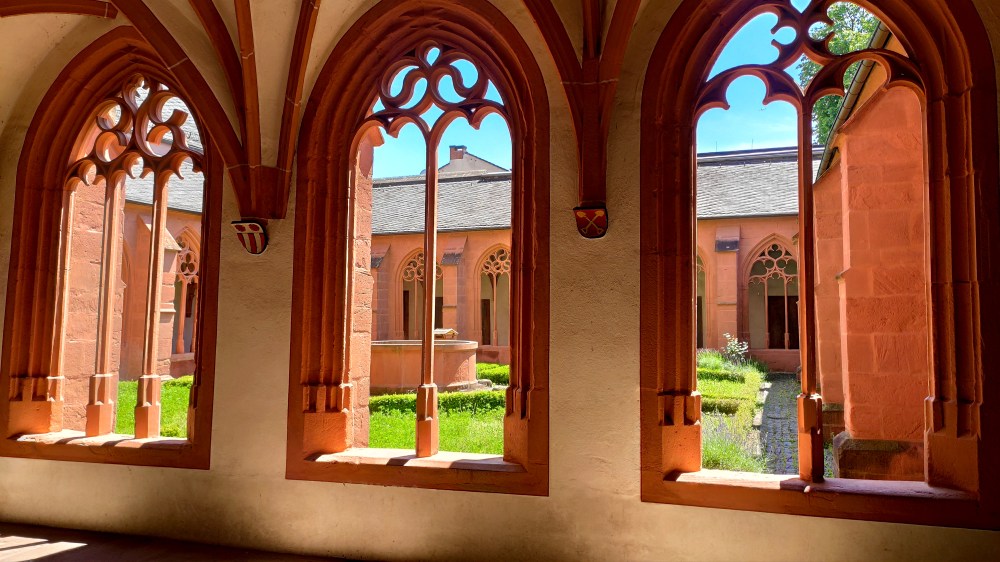
Opposite the entrance is a door leading to the cloister. The bright red stonework and green courtyard stand in stark contrast to the somber blues you just left behind.
3 – Fastnachtsbrunnen (Carnival fountain)
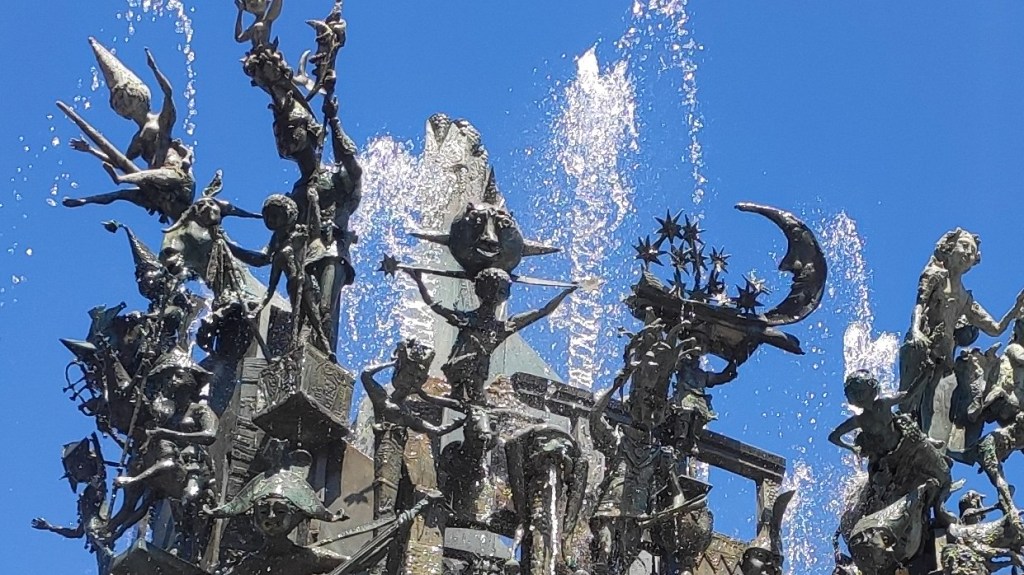
Unless you take a guided tour I imagine a lot of tourists just walking past this amazing fountain, maybe giving it a sideways glance and moving on. But this weird looking water structure is an important symbol for one of Mainz’s biggest events and official “5th season”: Carnival.

The original pagan history of the event (which you can still primarily find in the south of Germany) has been overtaken by Mainz’s colorful past of being occupied by France, multiple times, and carnival evolved into a way to express veiled dissatisfaction with the occupations. Or maybe I should say “thinly veiled”, as the official carnival colors in Mainz are Red-White-Blue-Yellow (I imagine the design discussion back then going something like: “Hey, let’s add the yellow, so no one realizes we’re really mocking the French”) and you will find the number 11 on many Guard costumes and throughout carnival. Why? The German word for 11 – elf – is short for Égalité, Liberté, Fraternité, the motto of the French revolution.
The amount of detail that goes into celebrating Carnival in Mainz is extraordinary, and it is reflected in the over 200 statues that make up the fountain, every one of them with its own intricate backstory – take a few minutes and explore all the details.
PS: I should add that relations with France, especially in the Rhineland-Palatinate area and Mainz, are very amicable today. After WWII and with the history of all those occupations, a lot of work was put into establishing exchange programs, city partnerships and celebrating each other’s culture, and it is not unusual to start with French as your first foreign language here, even before English.
4 – 50° N
Drawing a line between the theatre and the statue of Gutenberg (we’ll get to him in a second), you can stand at exactly 50° Northern Latitude. Funnily, 50°N is also more or less where the US borders on Canada. This always feels weird to me as I picture the US much further north.
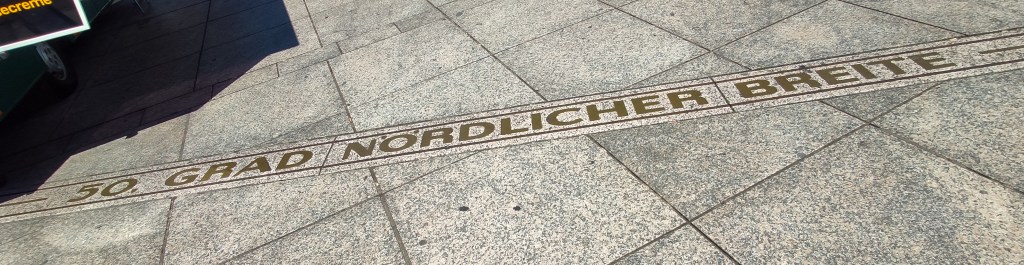
That’s it. I just think it’s neat, not many cities are exactly on top of a straight latitude line.
5 – The birthplace of the printing press
Conveniently, a statue of Gutenberg is right next to the 50°N band, so now is the time to snap a selfie with the person who revolutionized information before you head over to the Gutenberg museum.
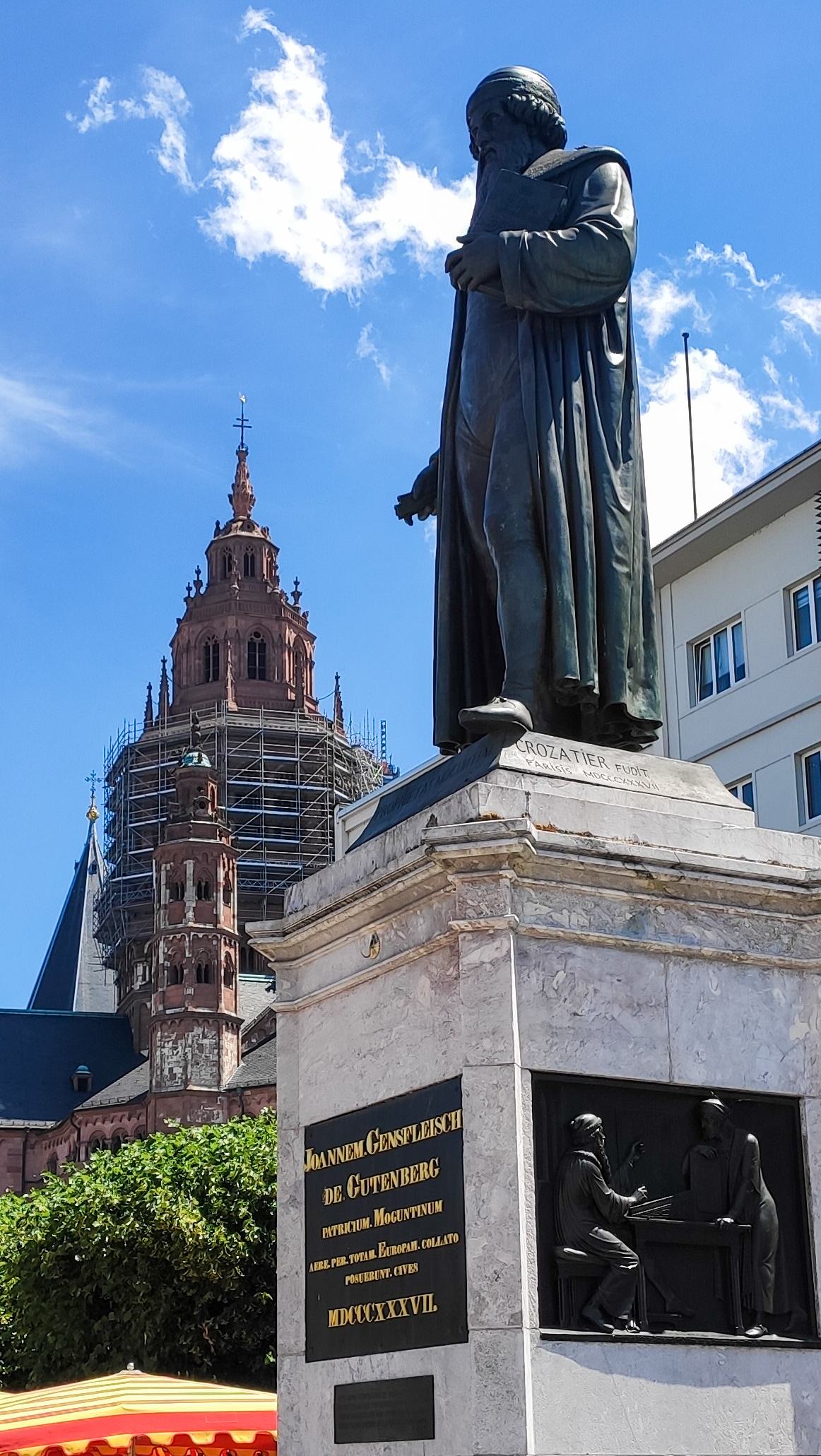
The museum hosts what you would expect: lots of printing presses and anything related to the history of printing. But there are three things I specifically love about the museum:
- It spells out Gutenberg in front on stone blocks, each decorated with a piece of technology at a specific point in history, progressing as you continue along the name.
- There are only a few original Gutenberg bibles left in the world, the museum is your chance to see two of them.
- In the downstairs section of the museum you can watch a live demonstration of how the press works every hour on the hour (check with the museum in case the times change). Last time I was there, no one volunteered to be the printer, so I did and got to print my own page of the Gutenberg bible which I got to keep. The demo is free and no sign up is required.

6 – Sanctuary of Isis and Magna Mater
The Isis temple is one of my favourite sights in Mainz and it is one of the most recent Roman discoveries. The Römerpassage mall (which actually derived its name from this find; Römer meaning Roman) had just started construction when I was in high school and as it goes in Mainz: when they started digging, they hit Roman ruins.

It was discovered to be a temple dedicated to the Isis and Magna Mater (“The Great Mother”), which as you might imagine, this not being Egypt nor Greece and all, was incredibly unusual. This almost made construction of the mall impossible, after all you can’t just destroy such a rare find. But what the planners did was, they simply built the mall on top of the temple! So now there is a museum in the mall’s basement where you can visit the temple and learn why it’s so unusual and how it came to be there.
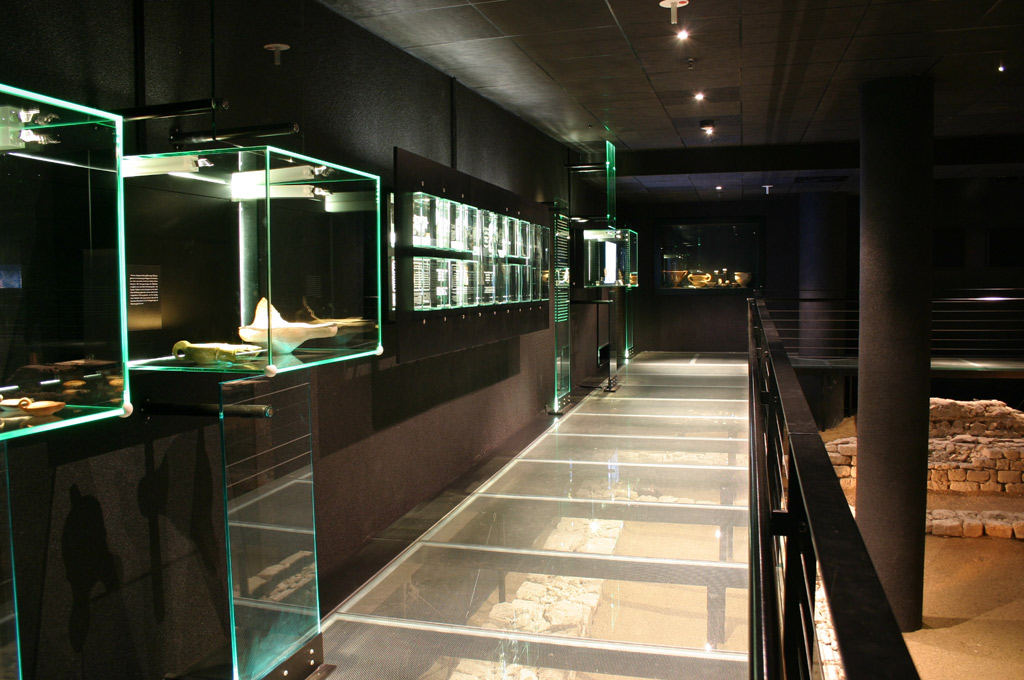
The museum itself is incredibly cool and modern, and best of all: It’s free!
(Donations are encouraged)
Also, the Römerpassage has one of the best ice cream places in the city. Just saying.
7 – Rhine promenade
Buy some ice cream and take a break from all the sightseeing by simply strolling down the pedestrian Rhine promenade all the way to the point where the Rhine and Main rivers meet and where Mainz got its name.

This is also where the tour boats leave if you feel like a river cruise.
8 – Roman theatre
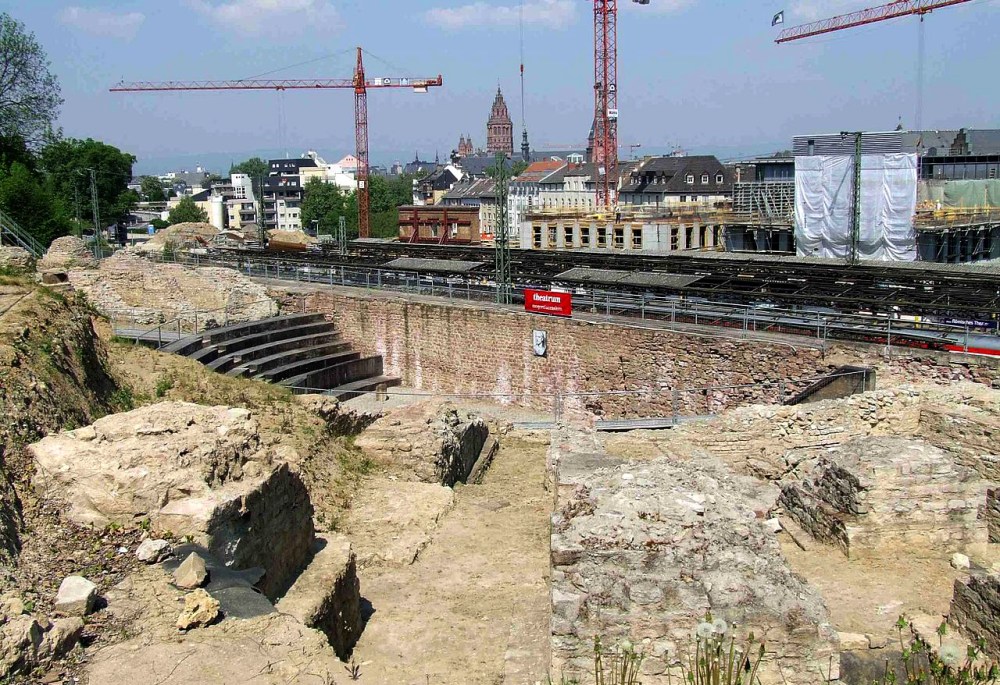
The Roman theatre has a similar story to the Isis temple, in that it was only just excavated in the late 90s. They kind of knew it was there since the construction of the Mainz South train station (since then renamed to “Mainz Römisches Theater”) but no one had really bothered to look into it. According to wikipedia, it “was the largest Roman theatre north of the Alps, seating some 10,000 visitors”3.
You can see it from the train, right next to the platform, so it’s the easiest sight to get to.
9 – Old town
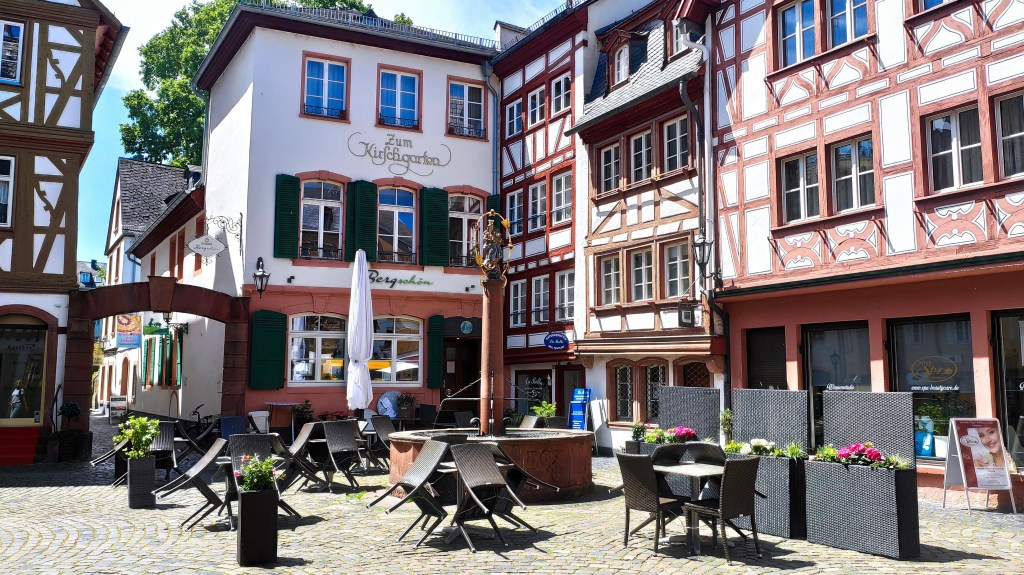
The best part of the Altstadt is the Augustinergasse and its criss-crossing side streets. The timbered houses and baroque-style Augustinerkirche is what my friends tell me all of Germany should look like. It’s a pedestrian street so you can take your time and explore everywhere.

My favourite Altstadt spot is the Kirschgarten which is just super cute.
10 – Wildlife Park Gonsenheim and Mainz Sand Dunes
The Wildpark in Gonsenheim is where I love going every time I come home. The park is small but free and is super popular with families on the weekend. Buy some fodder to support the park and feed the deer, goats and mouflons through the fences. All animals are what you would find locally, like the different kinds of deer, wild boars (wild boar babies are the best), mangalica (“sheep pigs”), peacocks, pheasants, a racoon (I swear I have never seen this guy, he always hides in his little tree trunk), a fox, rabbits, hens, guinea pigs and usually a wild cat or lynx.

It’s not very big but it’s right by the edge of the Lennebergwald and the Mainz Sand Dunes nature preserve. These inland dunes with their fine white sand are a weird remnant from the last ice age. It has some unique flora and fauna that can usually only be found in southeastern Europe or Asian steppes and are listed on the IUCN Red List of Threatened Species.

Map
I marked all sights on the map, so you can decide yourself in which order to see them.
Getting there and around
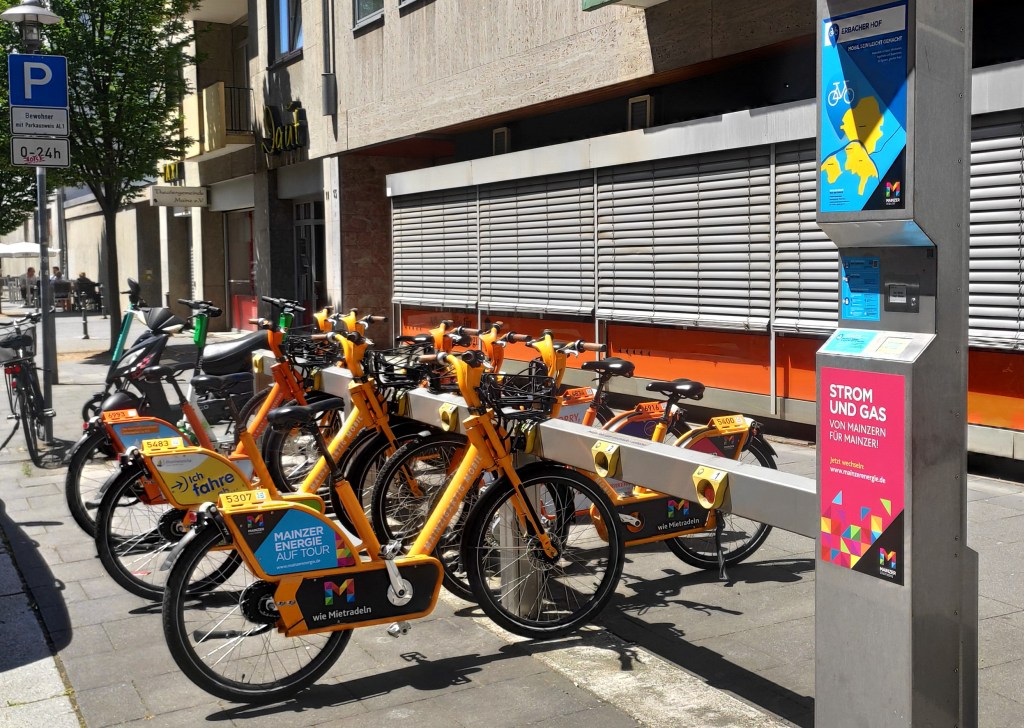
Mainz is the perfect size, not too big, not too small. In the center you can walk everywhere (I do) or take a rental bike that can be found near bus stops, parks, etc. I believe rental scooters like Lime are now also a thing, so take your pick. Of course public transportation is excellent in Germany, so hopping on a bus or tram is just as easy.
For all my points 1-9 you can just take a train to the Main station (Hbf) or Roman Theatre station and walk from there. For point 10 take the trams 50 or 51 direction of Finthen to Kapellenstraße (~20 minutes) and walk the rest.
You can reach Mainz by train from any major train station, and by S-Bahn from Frankfurt.
So that’s it, the quirky little town that I grew up in. It has lots more to see: the Natural History Museum, the State Museum, the Museum of Ancient Seafaring, a Roman aquaeduct (love the aquaeduct but it’s a bit out of the way, so I usually skip it in my tours), so many old churches that I don’t even know where to begin, Mainzelmännchen, bars and restaurants galore, river cruises, wine tours (remember to go for a walk in the vineyards), theatre…
The S-Bahn takes less than half an hour from Frankfurt Airport, so why not stay here for the night instead?
 Go Every Place